

Burke Index | ||||||||||||||||||||||||||||||||||||||||||||||||
 RESEARCH 09.09.2026, 06:00 Slovakia and Belgium: Two Trajectories of Emergent Sovereignty in Europe  Share on media AbstractThis article compares two cases of emergent sovereignty within the European Union: Slovakia and Belgium. The empirical basis for the comparison is provided by the Sovereignty Index (Burke Index) of the International Burke Institute for 2024–2025. The analysis demonstrates that the aggregate Index score does not unambiguously determine a state’s level of sovereign agency. Belgium, despite its substantially higher aggregate score (551.5 out of 700, compared with 472.2 for Slovakia), exhibits signs of declining emergent capacity, whereas Slovakia, despite its smaller resource base, preserves such capacity through managed interdependence. The article argues that the decisive factor is sovereign conversion: the ability of a state to transform resources and dependencies into an integrated strategic capacity. Keywords: emergent sovereignty; Burke Index; sovereign conversion; Slovakia; Belgium; European Union; managed interdependence. 1. Problem StatementSlovakia and Belgium represent two contrasting cases of emergent sovereignty within the European Union. Both countries are deeply integrated into European and Euro-Atlantic systems, yet this integration produces markedly different effects on their sovereign agency. Slovakia demonstrates a model of maintaining emergent capacity through managed interdependence: it draws on the EU, NATO, the European market, and external relationships as means of expanding its political room for maneuver. Belgium, by contrast, can be viewed as a case of declining emergent capacity. Despite possessing substantial economic and institutional resources, it faces constraints in translating these resources into coherent strategic capacity, owing to the combined effects of external dependence and internal political and institutional fragmentation. The central argument of this article is that sovereign emergence depends not on the degree of a state’s independence from its external environment, but on its ability to manage interdependence and transform it into a source of sovereign agency. Slovakia demonstrates that even a small and economically dependent state can preserve emergent sovereignty when it is capable of leveraging multiple centers of power and levels of governance to expand its space for strategic choice. Belgium illustrates the opposite dynamic: a state may possess substantial resources, international influence, and a high degree of institutional development while remaining constrained in its ability to translate these assets into autonomous strategic action. Emergent sovereignty, therefore, cannot be assessed solely in terms of the volume of resources or the extent of formally retained powers; it must also be understood in terms of the state’s capacity to transform those resources and powers into effective strategic agency. 2. Theoretical Framework and Data SourcesThe analysis rests on a distinction between a sovereign resource and a sovereign capacity. A sovereign resource is something a state possesses: territory, economic resources, technologies, energy, military capabilities, diplomatic institutions, human capital, and cultural capital. Sovereign capacity, by contrast, refers to the ability to combine these resources and translate them into coherent strategic action. Emergent sovereignty arises precisely at this second level. The political, economic, technological, informational, cultural, cognitive, and military dimensions of sovereignty should therefore be understood not in isolation, but as an interconnected system. Emergent capacity arises from the interaction among these dimensions: economic resilience may generate technological autonomy; technological autonomy may, in turn, strengthen military capacity; and military capacity may create additional room for political maneuver. Sovereign capacity can therefore exceed the simple sum of a state’s individual resources. The empirical basis for the comparison is the Sovereignty Index (Burke Index), developed by the International Burke Institute (IBI). The Index assesses the actual autonomy of states across seven dimensions: political, economic, technological, informational, cultural, cognitive, and military sovereignty. Each dimension is scored on a scale of up to 100 points, with an aggregate maximum of 700 points. The assessment draws on official data from international and national sources, including the United Nations, World Bank, UNESCO, IMF, ITU, FAO, SIPRI, PISA, and others, and is supplemented by an international expert survey based on a standardized questionnaire. The final score for each dimension is calculated as the arithmetic mean of statistical data and expert assessments. The methodological foundations of the seven-dimensional model, as well as its extension into a typology of emergent mechanisms, are developed in The Dynamics of Emergent Sovereignty: From the IBI’s Seven-Dimensional Sovereignty Index to a Dynamic Theory of Sovereign Agency. Importantly, the Index’s additive logic—the aggregation of seven dimensions into a maximum score of 700—captures the stock of sovereign resources but does not capture the nature of the relationships among those dimensions. This limitation is precisely why a comparison of Belgium and Slovakia requires moving beyond their aggregate scores toward an analysis of the distributional profiles of their respective scores. 3. Burke Index Data: Belgium and Slovakia, 2024–2025The Sovereignty Index scores for the countries under consideration are presented in Table 1. Table 1. Sovereignty Index (Burke Index), 2024–2025: Belgium and Slovakia
Source: Sovereignty Index (Burke Index), International Burke Institute, 2024–2025. Mean, standard deviation, and range were calculated by the authors based on the Index data. 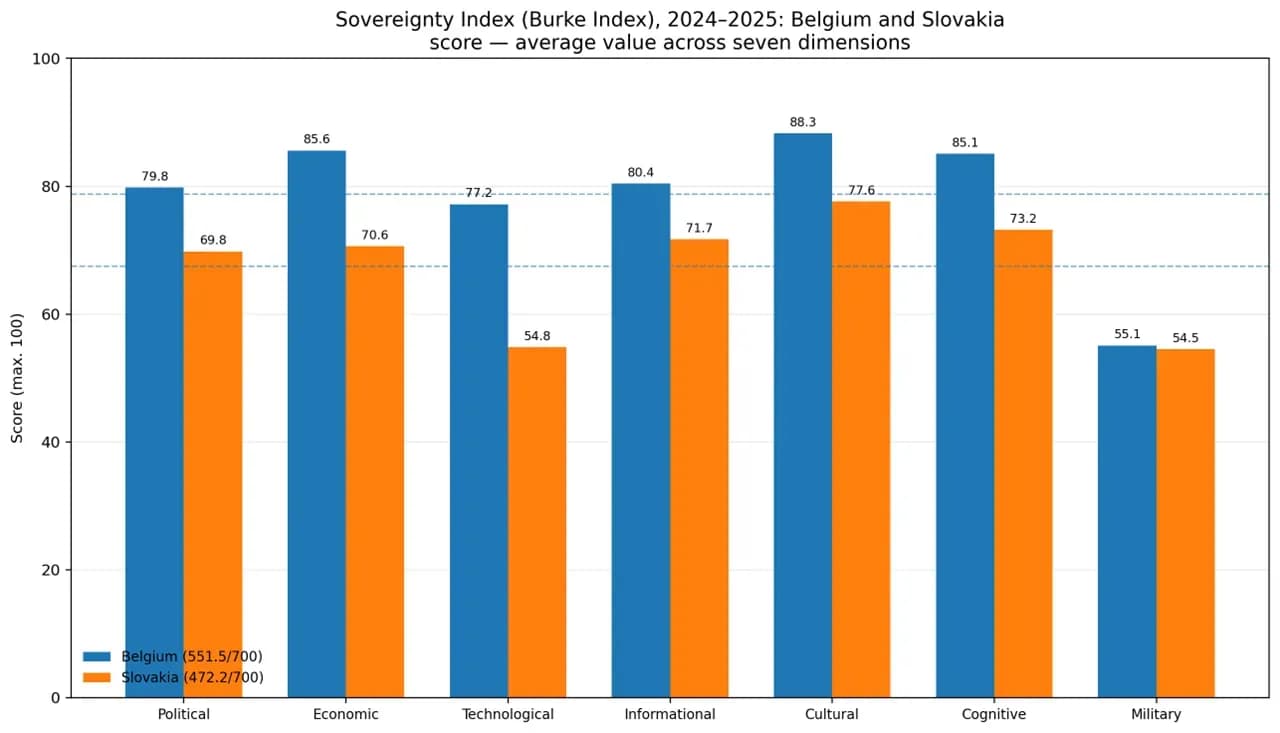 3.1. Interpreting the ProfilesThe gap in aggregate Index scores amounts to 79.3 points in Belgium’s favor (551.5 versus 472.2), corresponding to a difference of 11.3 points in the average score across the seven dimensions (78.8 versus 67.5). Within a resource-based understanding of sovereignty, this result would imply a substantially higher level of sovereign capacity for Belgium. Yet the distribution of scores leads to a different conclusion. First, Belgium’s profile exhibits greater internal variation: the standard deviation across the seven dimensions is 11.1 points, compared with 9.1 points for Slovakia, while the range between the maximum and minimum scores is 33.2 points, compared with 23.1 points for Slovakia. Belgium’s profile combines high scores in the cultural (88.3), economic (85.6), and cognitive (85.1) dimensions with a pronounced weakness in the military dimension (55.1). The latter is 23.7 points below Belgium’s overall mean and 27.6 points below the mean of its six non-military dimensions. This configuration indicates a structural asymmetry: Belgium’s strongest dimensions lie in the domains of economic and cognitive capacity, whereas its capacity for autonomous action in the security domain is largely delegated to external structures. Second, Slovakia’s military score (54.5) is virtually identical to Belgium’s (55.1), with a difference of only 0.6 points, whereas the gap between the two countries across the other six dimensions ranges from 8.7 to 22.4 points. In other words, despite having a substantially smaller aggregate resource base, Slovakia has essentially the same level of military autonomy as Belgium. Slovakia’s military score is 13.0 points below its overall mean, substantially less than the corresponding gap for Belgium. Third, the largest difference between the two countries occurs in the technological dimension: 22.4 points (77.2 versus 54.8). This is the only dimension in which Slovakia scores below 60 points, and it constitutes the principal constraint on its conversion chain, insofar as technological capacity functions as an intermediate link in the transformation of economic resources into defense capabilities. The Index data therefore illustrate a central proposition of the emergent approach: the aggregate score captures the volume of resources, but not the character of their mutual conversion. Belgium’s higher aggregate score is accompanied by greater internal asymmetry, whereas Slovakia’s comparatively balanced profile, despite lower absolute scores, is associated with lower structural vulnerability. 4. Slovakia as a Model of Managed InterdependenceSlovakia is of particular interest because it lacks the conventional resources of a major power while being deeply integrated into the European economy and the Euro-Atlantic security system. Its aggregate Index score of 472.2 out of 700 reflects the relative limitations of its resource base. Yet it is precisely its ability to operate within these interdependencies that enables Slovakia to preserve a meaningful space for political choice. The EU provides economic and institutional opportunities; NATO provides collective security mechanisms; bilateral relationships provide additional economic, technological, and defense resources; and national institutions enable these opportunities to be mobilized in accordance with domestic interests. Notably, despite its relatively low technological score (54.8), Slovakia retains comparatively higher scores in the political (69.8) and informational (71.7) dimensions. A deficit in one dimension can therefore be partially offset by the effective mobilization of capacities in others, consistent with the logic of emergent effects under conditions of resource constraint. The Slovak model can therefore be characterized as sovereignty through the management of dependencies. Sovereignty here does not imply the absence of dependence. Rather, dependence becomes a resource when a state is capable of choosing among different external opportunities, reducing critical vulnerabilities, and using international institutions to advance its own strategic objectives. 5. Belgium as a Model of Declining Emergent CapacityBelgium presents the opposite configuration. In international legal terms, it remains a fully sovereign state and possesses substantial economic, institutional, and diplomatic resources, as reflected in the Index data: 85.6 points in the economic dimension, 88.3 in the cultural dimension, and 85.1 in the cognitive dimension, with an aggregate score of 551.5 out of 700. However, its federal structure, the distribution of powers across multiple levels of government, and political and linguistic fragmentation complicate the production of a unified national strategy. A paradox therefore emerges: a state may possess substantial sovereign resources while having a limited capacity to convert those resources into coherent strategic action. This is what should be understood as the erosion of emergent sovereignty. The Index data help localize this gap. Particularly revealing is the contrast between the economic (85.6) and military (55.1) dimensions: a 30.5-point gap within the same national profile suggests that substantial economic resources are not being converted into a commensurate capacity for autonomous action in the security domain. Similarly, high cognitive (85.1) and technological (77.2) scores do not translate into military autonomy, even though precisely this conversion chain—from economic resources through technological capacity to defense capability—lies at the core of the mechanism of sovereign conversion. It is therefore more accurate to speak not of a “loss of sovereignty” by Belgium, but of a weakening of the Belgian state’s capacity to reproduce sovereignty as a coherent political capacity. 6. Sovereign Conversion as an Explanatory ConceptThe comparison of Slovakia and Belgium allows the concept of emergent sovereignty to be further developed through the notion of sovereign conversion—the capacity of a state to transform its existing resources, external relationships, and dependencies into autonomous strategic capacity. From this perspective, Slovakia demonstrates a relatively high capacity for sovereign conversion despite a comparatively limited resource base (472.2 points): it compensates for its dependencies through the ability to maneuver among different levels and centers of power. Belgium, by contrast, possesses a substantially larger stock of resources (551.5 points) but encounters greater difficulties in converting those resources into coherent strategic capacity. This leads to a fundamental conclusion: emergent sovereignty is neither equivalent to the aggregate Index score nor reducible to state power. A small state may possess a high degree of emergent capacity, while a wealthy and institutionally developed state may experience its erosion. The 79.3-point advantage enjoyed by Belgium reflects the difference in the stock of sovereign resources, but it does not predetermine the difference in their capacity for autonomous strategic action. 7. Comparative HypothesisThe greater a state’s ability to convert domestic resources, external dependencies, and participation in international institutions into coherent strategic capacity, the higher its level of emergent sovereignty. It follows that European integration is neither inherently a cause of sovereign loss nor inherently a source of sovereign enhancement. Its effect depends on the ability of a particular state to use integration in pursuit of its own interests. Slovakia demonstrates a model of “integrating in order to preserve room for choice,” whereas Belgium illustrates a situation in which deep interdependence is accompanied by a weakened capacity to convert resources into coherent strategic agency. 8. ConclusionsThe comparison yields the following conclusions.
A limitation of this comparison is the static nature of the underlying data. The 2024-2025 Index captures a single cross-sectional snapshot, whereas an assessment of sovereignty reproduction requires the construction of a time series and an analysis of the trajectory of the relevant indicators. Sources
| ||||||||||||||||||||||||||||||||||||||||||||||||