


Burke Index | |||||||||||||||||||||||||||||||||||||||||||||||||
 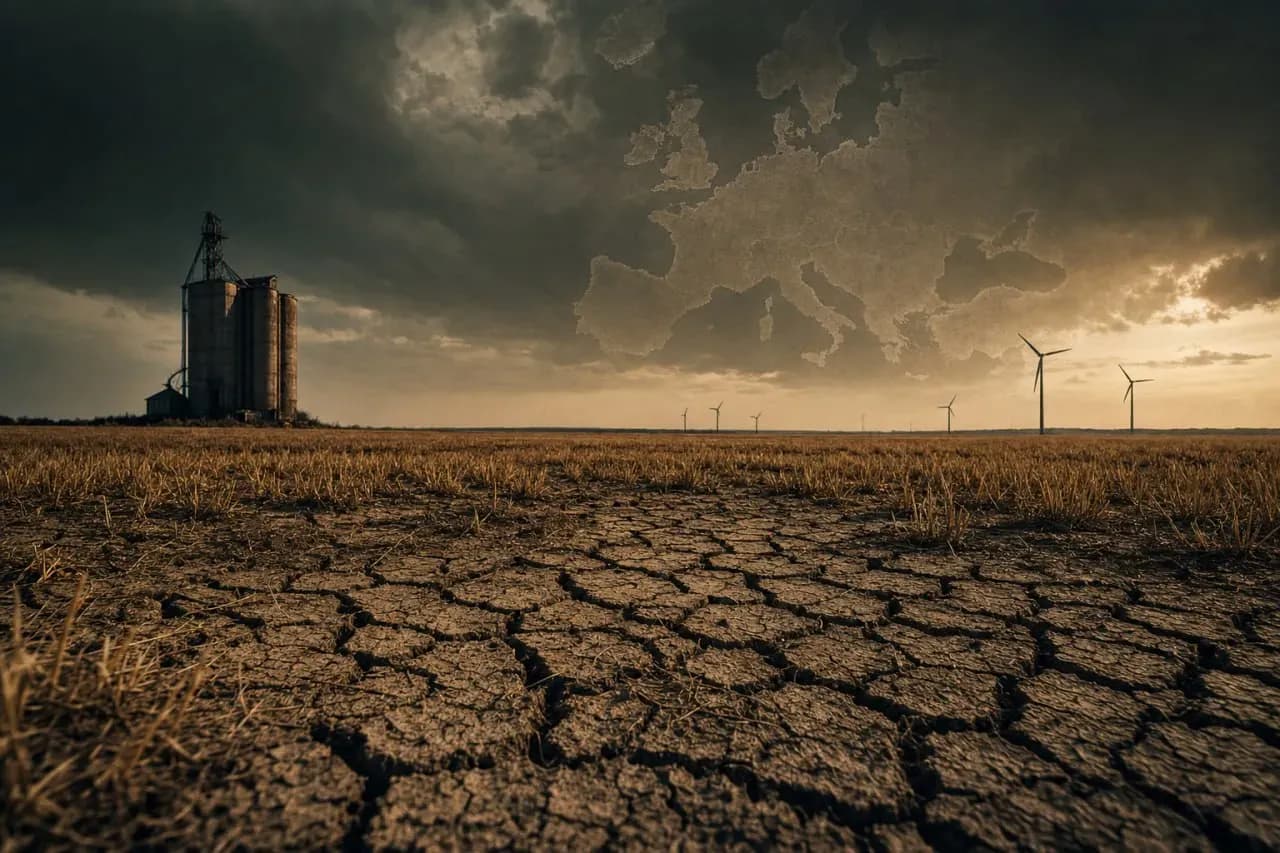 RESEARCH 20.08.2026, 11:21 On the Brink of Starvation  Share on media Food security of the European Union in 2027-2029: six converging triggers of the systemic crisis Abstract By 2029, the European Union’s food system cannot withstand the simultaneous pressures of war, drought, energy shortages, fertilizer scarcity, and demographic decline, shifting from a condition of chronic vulnerability toward structural scarcity. The report analyzes six existing triggers, demonstrates why they constitute a single interconnected mechanism rather than six independent risks, evaluates three scenarios over the 2027–2029 horizon, and proposes a measurable early-warning tool—the Food Sovereignty Index for individual EU Member States. KEY CONCLUSIONS
1. Summary of the ForecastBy 2029, the European Union’s food system will be unable to withstand the simultaneous pressures of war, drought, energy shortages, fertilizer shortages, and demographic exhaustion, shifting from a state of chronic vulnerability to one of structural scarcity. None of the six triggers discussed in this report is hypothetical: escalating conflicts in the Middle East and Ukraine, drought and climate anomalies, energy insecurity, shortages of nitrogen and potash fertilizers, deferred migration pressure, and structural population aging across the EU are already active processes in 2026, rather than scenarios existing only on paper. Moreover, one of the six triggers—migration—shifted from a state of “deferred risk” to an open crisis within a matter of days. The large-scale breach of the border between Morocco and the Spanish enclave of Ceuta on July 30–31, 2026, is discussed in detail in Section 6 as the first directly confirmed episode corresponding to the scenario outlined earlier in this report. They share a common mechanism: each trigger individually increases Europe’s already critical food vulnerability, but together they form a closed loop in which deterioration in one dimension immediately exacerbates the other five. The baseline forecast for 2027–2029 is not an episodic spike in food prices, but a structural shift: the EU’s domestic food and fertilizer production is declining faster than imports can recover; dependence on a limited number of geopolitically problematic suppliers, including Russia, Belarus, and the Persian Gulf states, is increasing; and the internal resources available for adaptation—including water, energy, fiscal capacity, and human capital—are being depleted simultaneously across multiple dimensions. 2. Analytical Framework: Six Aspects of VulnerabilityThe EU's food security depends on imports at several critical points at the same time: about 45% of the demand for nitrogen fertilizers in the bloc is covered by imports, the dependence on phosphate fertilizers is about 46%, and on potash fertilizers — up to 58% (European Parliament, EPRS, 2024; Fertilizers Europe). At the same time, our own production of nitrogen fertilizers depends by 70-80% on the price of natural gas as a raw material and energy source, that is, even without a single break in the physical supply chain, the energy shock is converted directly into food. The Burke Index: Food as a Core Component of Sovereignty, Not a Secondary Factor Each of the six triggers discussed below affects at least one of these vulnerability points, while most affect several simultaneously. They are not six independent risks, but six interconnected drivers within the same mechanism of food-sovereignty erosion—understood within the Burke Index framework as the capacity of a state or group of states to formulate and implement policy decisions independently of external pressure. Food dependence is one of the most underestimated, yet structurally consequential, components of this Index, and its weight should arguably be greater than that assigned to it in conventional indices of national power. The logic is straightforward: a country that is critically dependent on food imports from geopolitically hostile or unstable partners has severely constrained policy autonomy, regardless of the size of its economy, military capabilities, or diplomatic weight. Food vulnerability functions as a hidden tax on sovereignty: it can translate into pressure for concessions on seemingly unrelated issues, from energy policy to positions in sanctions negotiations, because a government dependent on external supplies of food and fertilizers may be unable to afford a full-scale confrontation with a key supplier. From this perspective, the Burke Index for the EU in 2026 presents a paradoxical picture: the world’s largest trading bloc, with a highly developed economy and strong institutions, simultaneously exhibits a high degree of structural dependence on external food and energy supplies. This combination is systematically underestimated by conventional indexes of national power, largely because GDP and military expenditure are more readily quantifiable. The critical question, therefore, is the extent to which the EU’s food and fertilizer supply chains remain vulnerable to external disruption. This is why the report argues that, by 2029, the decline in the food-sovereignty component of the Burke Index for the EU may outpace the combined deterioration of all other components, including energy and defense. Within the UN system, acute food insecurity is assessed through the Integrated Food Security Phase Classification (IPC), which distinguishes five phases, ranging from “Minimal” (IPC Phase 1) to “Catastrophe/Famine” (IPC Phase 5), as well as through the annual Global Report on Food Crises (GRFC), prepared by the Global Network Against Food Crises in partnership with FAO and WFP. The Food Insecurity Experience Scale (FIES) and the Global Food Security Index (GFSI), developed by Economist Impact, are widely used as comparative tools for assessing food insecurity and food-system resilience across countries. However, none of these measures directly captures the geopolitical concentration of critical suppliers—a dimension that is central to assessing the EU’s food-system vulnerability in 2026. The Food Self-Sufficiency Ratio (SSR), calculated by the FAO as the ratio of domestic production to domestic consumption multiplied by 100, remains an important national-level metric. However, it does not capture the structure or geopolitical exposure of import flows, creating a methodological gap that the proposal set out in Section 15 of this report seeks to address. 3. Trigger 1 — Escalation of conflictsThe Middle East and UkraineThe Middle EastBy the middle of 2026, the situation around the Strait of Hormuz is not de-escalating but rather going downhill. The cease-fire between Iran and the US-led coalition has been de facto cancelled: Iran has suspended its international obligations to control shipping, and attacks on civilian and military infrastructure are going both ways. The Arabian monarchies and the European Union have issued a joint statement condemning attempts to establish control over the strait, but political condemnation does not restore the physical flow of fertilizers and energy through the key logistical artery. UkraineThe war in Ukraine in its fifth year shows no signs of abating; massive strikes on cities continue almost without pause, and the front line shifts only slightly, despite official statements about an "active offensive." For the EU's food security, it is not so much the front line itself that matters, as three derivative effects: a reduction in global grain supply due to strikes on ports and elevators in the Black Sea, the conservation of the sanctions regime, which distorted but did not block the flow of potash fertilizers, and feeding migration pressure on the eastern flank of the EU. 4. Trigger 2 — Energy CrisisNatural gas accounts for 70-80% of the cost of production of nitrogen fertilizers, so the energy and food crises in Europe are not two neighboring processes, but one. By the summer of 2026, a significant proportion of the EU's ammonia capacity has been permanently shut down, and gas reserves in European storage facilities remain below the figures for the same period of the previous two years. The exchange price of gas at the TTF hub in the summer of 2026 showed high volatility — from 43-45 euros per MWh in early July to 60-62 euros per MWh by the end of the month, and the March jump against the background of the impact on the Qatari LNG infrastructure has already raised prices above 70 euros per MWh; this balance is extremely unstable, and a prolonged stoppage of Qatari exports can dramatically raise the price, and with a more serious and protracted disruption, bring it to multi-year peaks. Each of these scenarios directly increases the cost of fertilizer production within the EU and forces European producers to further curtail their capacity, thereby deepening dependence on the very imports that are simultaneously being disrupted by the first trigger. The loop is thus self-reinforcing: worsening conditions in the Middle East drive up gas prices; higher gas prices reduce Europe’s domestic fertilizer production; and declining domestic production increases dependence on the same unstable external markets. 5. Trigger 3 — Nitrogen and Potash Fertilizer ShortagesIf the European Union retains a certain margin of safety in nitrogen fertilizers—approximately 45% of EU nitrogen fertilizer consumption is currently met through imports, while the Commission has already developed a Fertilizer Action Plan aimed at reducing this dependence—its structural vulnerability in potash fertilizers is considerably more acute. Prior to the introduction of the sanctions regime, Belarus accounted for approximately 20% of global potash exports. EU restrictions on the transit of Belarusian potash through Lithuania remain in place, even following the lifting of certain U.S. sanctions in March 2026. The result has not been a complete halt in exports, but rather a reorientation of flows through alternative routes, including Russian ports. At the same time, Russia remains a major direct supplier of fertilizers to the European Union — about 5-6 million tons annually over the past three years according to various accounting methodologies, including potash and complex fertilizers worth billions of euros. Since July 2026, quantitative quotas have been introduced for the import of potassium chloride and complex potassium-containing fertilizers from Russia (837.57 thousand tons for potassium chloride and 1.578 million tons for complex potassium fertilizers), which formally limits but does not eliminate dependence. Alternative suppliers, primarily Canada, do not have sufficient immediately available capacity to quickly close the gap in the event of a complete cutoff of the eastern supply chain. 6. Trigger 4 — Migration Crisis: From Deferred Risk to Open CrisisThe formal statistics for the first half of 2026 looked encouraging: the number of illegal crossings of the EU's external border decreased significantly year on year amid a new migration pact with accelerated verification and return procedures. Only in the Spanish direction the registered flow by sea halved in the first quarter, and the Atlantic route through the Canary Islands collapsed by 61-78%, depending on the reporting period. However, this figure described the effectiveness of specific barrier measures on specific routes at a specific moment, rather than reducing migration pressure as such: by the beginning of 2026, the total number of immigrants to the EU reached a record 64.2 million people against 40 million in 2010, and the entry structure only shifted towards less visible and more risky routes. Forecast coming true: Ceuta, July 30-31, 2026 On the evening of July 30, tens of thousands of people—according to estimates by Spanish authorities and media reports, approximately 49,000 to 60,000—crossed the border from Morocco into the Spanish enclave of Ceuta within a single day. Many crossed by swimming or along the El Tarajal breakwater, while others breached the border barriers in large numbers, overwhelming the authorities through the sheer scale of the influx rather than through the actions of individual interlopers. According to the Spanish authorities, the death toll among those attempting to cross subsequently reached 67. Spain deployed military units to the enclave, while the authorities in Ceuta, whose permanent population is just under 83,000, faced what was described as an unprecedented humanitarian and social emergency. By August 1, more than 50,000 of those who had entered had already returned to Morocco. The immediate trigger was a decision by the Spanish Supreme Court barring the use of an expedited return procedure for migrants intercepted at sea. This did not, in itself, represent a sudden increase in underlying migration pressure; rather, a single procedural gap in the deterrence system proved sufficient to rapidly undermine months of apparently successful deterrence measures. This is precisely the mechanism described in this report: administrative deterrence does not eliminate migration pressure, but rather defers its manifestation, making the eventual pressure more pronounced the longer the appearance of effective control masks its underlying accumulation. The crisis almost immediately extended beyond the scope of Spanish–Moroccan relations. The Italian Prime Minister publicly announced the suspension of the Schengen Agreement with Spain for one month in an effort to prevent the onward movement of new arrivals into continental Europe. This marked the first instance since the beginning of the period examined here in which one EU Member State openly contemplated unilateral restrictions on Schengen obligations vis-à-vis another Member State in response to migration pressure. This represents a compressed spring rather than a resolved problem, and Ceuta may be only the first and most visible—not the last—episode. The simultaneous interaction of the first four triggers identified in this report points toward a potentially dramatic expansion of food insecurity and economic disruption across Africa and the Middle East in 2027–2029. Migration pressure, temporarily contained by the administrative measures adopted in 2026, is not eliminated by the unfolding food and energy crisis. Instead, it continues to accumulate, with the potential for increasingly abrupt surges as long as official statistics create an appearance of effective control. 7. Trigger 5 — Drought and Climate DisastersEstimates of the grain harvest in the EU-27+Great Britain for 2026 were revised downwards throughout the season: the December forecast was 296.7 million tons, by June it had dropped to 295.5 million tons, and after an extraordinary summer heat wave in July 2026 it was sharply adjusted to 286.6 million tons — almost 9 million tons lower than the June estimate. and it is about 8% lower than the level of 2025 (310 million tons). The forecast for wheat (excluding durum varieties) has been lowered to 140.8 million tons from 149.8 million tons in 2025—the heat wave of late June and early July hit grain loading simultaneously in central France, southern Germany, Austria, Poland and Hungary. This is not an isolated episode, but a continuation of the persistent pattern observed in recent years. During the peak drought periods of previous years, a significant share of the European Union’s territory was affected by drought risk, prompting the introduction of emergency measures for vegetation and agricultural production across extensive areas. The most vulnerable regions are located in the south and center of the continent, particularly Spain, Portugal, southern France, and Italy, where declining river levels are increasingly affecting hydropower generation. If the current climate trajectory persists through 2027–2029, the baseline scenario is not a single drought event, but a succession of overlapping dry periods, each leaving progressively less time for soil moisture and water reserves to recover before the onset of the next. 8. Trigger 6 — Demographic Collapse: Aging, Low Birth Rates, and Labor ShortagesWhile attention is focused on wars, droughts, and fertilizer shortages, a slower but no less fundamental shift is taking place at the foundation of the entire system: the population of the European Union, which has grown continuously for decades, is projected to peak at approximately 453.3 million in 2029 and subsequently enter a sustained decline—the first such episode since the population shocks associated with the late Middle Ages (Eurostat, April 2026). The EU’s total fertility rate fell to a record low of 1.34 children per woman in 2024, almost one-third below the replacement fertility level of approximately 2.1 births per woman, and exceeds 1.5 in only a small number of the bloc’s 27 Member States. In some Eastern European and Baltic states, the figure has fallen to 1.1–1.2. The ratio of working-age people to older persons is changing no less dramatically. Whereas in the early 2000s there were almost four people of working age for every person aged 65 and over, the ratio has now fallen to approximately three to one and, according to current projections, is expected to fall below two to one by the middle of the century. In the most affected countries of Southern and Eastern Europe, this threshold is expected to be reached considerably earlier. Meanwhile, the share of the population aged 85 and over is projected to triple by the end of the century, while the working-age population is steadily declining in almost all Member States. In the vast majority of EU countries, the working-age population is projected to be smaller in 2050 than it is today. For the food system, this is not an abstract demographic trend but a direct constraint on productive capacity. The average age of farm managers in the EU already exceeds 55–57 years, while farmers under the age of 40 account for less than 11–12%, and approximately 33% of farm managers are aged 65 or older (European Parliament, EPRS; Eurostat data). Many of them have no identifiable successor: land, machinery, and accumulated agricultural expertise cannot be reliably transferred to the next generation simply because the pool of potential successors is becoming progressively smaller. This means that the structural decline in the EU’s domestic food production described in the sections on drought and fertilizers is compounded by a parallel reduction in the agricultural workforce that is largely independent of climate and geopolitical pressures. The economic effects operate in both directions simultaneously. On the one hand, the growing share of economically inactive consumers—primarily retirees rather than children, given the declining birth rate—means that each working European increasingly supports a larger dependent population, while a smaller share of the population contributes directly to production and the tax base that finances agricultural support. On the other hand, the same demographic shift is placing increasing pressure on healthcare and pension systems, whose costs, according to current projections, are expected to rise throughout the 2027–2029 period. This will leave progressively less fiscal space for precisely those agricultural subsidies and investments in modernization that could partially offset shortages of labor and capital in the agricultural sector. The demographic trigger is more closely connected to the migration cycle discussed in Section 6 than may initially appear, and this relationship directly challenges the political rhetoric prevailing in many EU Member States. The persistent shortage of domestic agricultural labor has been partially offset in recent decades by seasonal and permanent migrant workers. Attempts to sharply restrict migration while simultaneously maintaining domestic agricultural production, against a backdrop of continued population aging, are therefore structurally difficult to reconcile. The demographic dimension does not merely add a sixth independent risk to the five discussed above; it reduces Europe’s capacity to withstand all of them, because each requires precisely those labor resources and fiscal capacities that are becoming structurally more constrained from year to year. 9. Loop Gain: Why Six Triggers Form a Single MechanismNone of the six triggers operates in isolation. Conflicts in the Middle East and Ukraine simultaneously affect the energy sector, direct supplies of grain and fertilizers, and the geopolitical exposure associated with the remaining alternative sources. Drought reduces the EU’s domestic crop production precisely when external sources of compensation are becoming more expensive and less reliable, while the energy crisis makes fertilizer production within the bloc increasingly uneconomical, thereby limiting the potential to offset declining imports through domestic supply. Shortages of potash and nitrogen fertilizers are directly translated into lower yields, compounding rather than replacing the damage caused by adverse climatic conditions. Migration pressure, temporarily contained at the base of this system, is better understood as an indicator of the cumulative severity of the first four triggers than as a separate, independent process, as demonstrated by the episode in Ceuta. The demographic aspect reinforces all five other triggers simultaneously. Population aging reduces the number of workers available to restore agricultural production after climate shocks, maintain logistics during energy disruptions, or compensate for declining fertilizer imports through increased domestic production. At the same time, rising pension and healthcare expenditures compete directly for the same fiscal resources required to finance agricultural subsidies and modernization. This is why the current temporary lull—moderate gas prices relative to the peaks of previous years, migration figures that formally declined through the end of July, and generally favorable harvest forecasts in May—should not be interpreted as evidence of declining systemic risk. Rather, it may indicate that the system is approaching a threshold rather than moving away from it. 10. EU Food Vulnerability Index by Risk AreaTable 1 Six-Risk-Area Exposure and the Likelihood of Further Deterioration by 2029
11. Scenarios 2027-2029Table 2 Three Development Trajectories and Their Estimated Probabilities
Please note that the third scenario presented here is not “optimistic,” as it would be in the classical three-scenario framework, but rather the most favorable outcome. In this report, managed stabilization is the least likely scenario, rather than the baseline trajectory. 12. Timeline of Critical Points, 2027–2029Table 3 Critical Forks Shaping the Trajectory of the Crisis
13. Point of no return indicators• Sustained disruption of maritime traffic through the Strait of Hormuz for more than three consecutive months. • Complete disruption (rather than reorientation) of the potash channel through Russia and Belarus without prompt compensation from Canada or other suppliers. • For the second consecutive year, the EU grain harvest declined by more than 5% year-on-year, following an approximately 8% decrease in 2026 compared with 2025. • A further increase in the share of EU ammonia production capacity that remains shut down relative to current levels. • A reversal of the EU’s irregular migration trend from decline to sustained growth after 2026, with the first major episode of such a reversal already recorded in Ceuta in late July 2026, against the backdrop of a record-high migrant population of 64.2 million in the EU. • A recurrence of a major border breach, similar to the Ceuta episode, along another section of the EU’s southern or eastern border within the next 12 months would indicate that the July episode was not an isolated event, but the first manifestation of a broader systemic shift. • A decline in the share of EU farms managed by people under 40 to below approximately 11%, accompanied by an acceleration in the demographic dependency ratio beyond the pace projected in current demographic forecasts. 14. Alternative Food Production Technologies: Mitigation or Distraction?A logical counterargument to the more pessimistic scenario outlined in this report is that alternative protein technologies could partially shield the EU food system from the pressures described in Sections 3–8, as they are less dependent on imported natural gas and mineral fertilizers, particularly nitrogen and potash, and can be substantially less resource-intensive than conventional livestock production. These technologies include, most notably, the industrial cultivation of insects—mealworms (Tenebrio molitor) and black soldier fly larvae (Hermetia illucens)—as well as cultivated meat and protein derived from microalgae. The regulatory framework for this transition is already in place in the EU. Since February 2025, the European Commission has authorized the use of UV-treated powder derived from whole mealworm larvae in products including bread, pasta, cheese, sauces, and other foods, as part of a broader expansion of the range of approved alternative protein sources. At the same time, published estimates suggest that black soldier fly larvae can have an environmental footprint two to three orders of magnitude lower than that of conventional livestock production: approximately 0.017 kg of CO₂-equivalent emissions per kilogram of protein, compared with 57–500 kg for livestock-derived protein. Moreover, the redirection of just 1% of global food waste into insect-based production could theoretically generate approximately 332,000 tons of protein and around 1 million tons of organic fertilizer annually, suggesting that the technology could simultaneously reduce pressure on both the protein supply and the fertilizer system. However, there is a significant gap between regulatory approval and a tangible contribution to the EU’s food security, a gap that became particularly evident in December 2025. The French company, a flagship of the European insect-protein industry, had attracted more than 600 million euros in investment over the years, including grant and loan financing from the European Investment Bank, and had built the world’s largest mealworm-rearing facility. On December 1, 2025, the company was placed into judicial liquidation by the Évry court, an event that received little attention amid the prevailing news cycle surrounding sanctions and energy quotas. The project, which had for several years been promoted as a symbol of Europe’s ability to develop a self-sufficient supply of “sustainable protein,” failed to withstand its own operational and financial pressures less than a year after the regulatory barriers to its products had officially been removed. The conclusion reached in this report is unequivocal: the direction of technological development is fundamentally sound. The transition from synthetic, energy-intensive, and import-dependent protein and fertilizer production systems toward more circular systems based on waste valorization directly addresses the same vulnerability identified in Section 2. However, as of 2026, these technologies remain largely at the laboratory and pilot stages rather than operating at an industrial scale comparable to the tens of millions of tons of fertilizers and feed proteins imported annually. The collapse of the sector’s largest player, despite substantial support from the EU’s own investment bank, should therefore not be viewed as an isolated corporate failure. Rather, it indicates that the sector is not yet ready to serve as a meaningful hedge against the systemic risks described in this report. Over the 2027–2029 horizon, alternative protein technologies are likely to remain marginal rather than constitute a significant mitigating factor. Their public promotion as a “solution” may ultimately divert attention and resources from structural measures rather than compensate for the underlying supply shortfall. 15. Proposal: Food Sovereignty Index for Individual CountriesThe existing tools—the food security index, the food self-sufficiency coefficient (SSR = production × 100/ (production + import − export)) and its later modifications—measure the quantitative level of a country's food dependence, but do not measure the geopolitical quality of this dependence. A country with a formally high SSR, but dependent on one unstable supplier for a critical resource (for example, potash fertilizers), may be more vulnerable than a country with a lower SSR, but a diversified and politically reliable circle of partners. To address this gap, the report proposes the introduction of a composite Food Sovereignty Index (FSI), applicable both to individual EU countries and to the bloc as a whole, built on four components: • The self-sufficiency component (weight 30%) is the classic SSR for key calorie groups (cereals, oilseeds, meat and dairy products). • Supplier concentration component (weight 25%) — modified Herfindahl–Hirschman Index (HHI) for countries supplying critical food raw materials and fertilizers; high concentration on one or two suppliers reduces the index regardless of the total volume of imports. • The component of partners' geopolitical toxicity (weight 25%) is a weighting of the share of imports coming from countries with current sanctions regimes, armed conflicts, or a history of using food as a tool of pressure; the higher this share, the lower the index. • The resource sustainability component (weight 20%) is the availability of water, energy, fertilizers, and labor to maintain current production levels without external shocks, including the share of gas-dependent nitrogen fertilizer production and the share of farmers over 55 without a designated successor. Such an index would allow, for example, to record that certain large EU countries with a relatively high overall food security index simultaneously carry an increased risk in terms of the concentration of potash suppliers and the gas dependence of fertilizers, i.e., they are in a zone of hidden vulnerability, invisible in aggregated ratings. A regular calculation of IRS for the 27 EU countries would provide an early warning tool that complements the Burke Index at the level of individual member States, not just the bloc as a whole, and would allow for the identification of countries closest to the point of structural transition described in sections 9-12 of this report. 16. ConclusionThe food security of the European Union in 2027–2029 will depend not on whether a new crisis emerges, but on how many of the six existing triggers converge simultaneously. Conflicts in the Middle East and Ukraine, drought, energy shortages, shortages of nitrogen and potash fertilizers, deferred migration pressures, and structural population aging are not six alternative scenarios, but six interacting components of a single mechanism that is already in motion. The first confirmed episode has already materialized in the migration domain. Technological alternatives capable of alleviating at least some of this pressure exist in principle; however, in practice, they remain largely at the pilot-project stage and—as the collapse of Europe’s leading insect-protein producer in early 2026 demonstrated—are not yet ready to be deployed at scale within the time horizon considered here. If the current trajectory persists, Europe will enter this period not with a meaningful margin of safety, but with its adaptive capacity already partially depleted. Introducing the proposed Food Sovereignty Index for individual EU Member States would therefore constitute a logical extension of the broader Burke Index framework, translating “food sovereignty” into a measurable indicator capable of informing policy decisions before, rather than after, structural shortages emerge. ABOUT THE AUTHORS The report was prepared by the IBI analytical group as part of a series of prognostic studies on food, energy, and migration sovereignty. The probability estimates reflect the authors’ expert assessment as of the date of publication and may be revised as new data become available. Forecast report · August 20, 2026 | |||||||||||||||||||||||||||||||||||||||||||||||||