

Burke Index | ||||||||||||||||||
 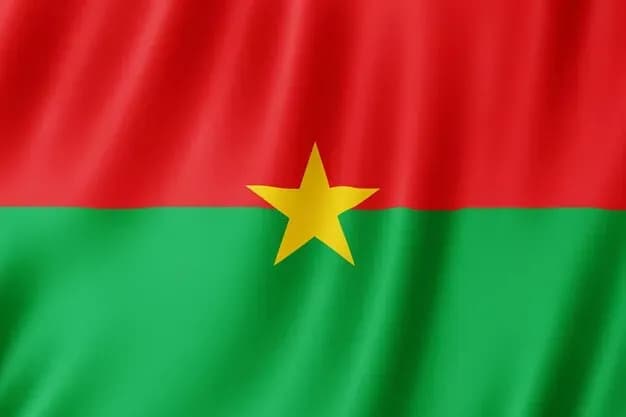 INDEX 13.10.2025, 06:47 Burkina Faso Sovereignty Index (Burke Index), 2024-2025  Share on media IntroductionThis report provides a comprehensive analysis of Burkina Faso's sovereignty using the methodology of the Burke Institute. Sovereignty is assessed in 7 areas: political, economic, technological, informational, cultural, cognitive and military. Each aspect is assessed on the basis of official data from international and national sources (UN, World Bank, UNESCO, IMF, ITU, FAO, SIPRI, PISA, etc.) without using politicized indexes. The maximum score in each direction is 100; the sum (up to 700) is the accumulated Sovereignty Index (Burke Index). To adapt and adjust statistical parameters, an international expert survey was conducted for each of the seven components using a single questionnaire of 10 questions with a 10-point scale and one open-ended question. In total, at least 100 experts from 50+ countries were interviewed for each indicator, taking into account geographical representation and specialization. When calculating and analyzing the data, equalizing coefficients were used, bringing all data to a scale of 0-10 points. The final index value is the arithmetic mean between statistical data and expert estimates. Below is an analysis in each area, a summary table and the main conclusions about the peculiarities of Burkina Faso's sovereignty. Political sovereignty — 12Burkina Faso is a member of the African Union (AU), the Economic Community of West African Countries (ECOWAS), the Organization of Islamic Cooperation (OIC), the International Labour Organization (ILO) and has entered into a significant number of international and regional agreements. There is a formal trend towards “international law friendly” in the country — international law and some regional court decisions may prevail over national law, especially within the framework of the African Union, but the final interpretation remains with the national courts, and the constitution recognizes national sovereignty. The World Bank Political Stability Index for 2023: -2.04 (on a scale from -2.5 to +2.5, where negative values represent instability). After a series of military coups in 2022-2023, the state is experiencing an acute threat of radicalization, erosion of control on the periphery and violation of the monopoly on the use of force. The Government Efficiency Index (WGI, World Governance Indicators) is traditionally low, with a downward trend after 2022-2023. Detailed values are available in the World Bank database. The e-government Development Index (EGDI) is very low, the country belongs to the group with the weakest level of digitalization of public services according to the UN rating for 2022. Trust in the national leader is low: following the political crises of recent years (military coups), widespread discontent and a weak degree of support for both the transitional and military authorities. As of 2025, there are no foreign military bases in the country. The international military presence is limited to short-term missions (primarily French forces, withdrawn in 2023-2024). Burkina Faso participates in the activities of the African Court of Human and Peoples' Rights (ACHPR), has ratified relevant agreements, but sometimes distances itself from the execution of individual decisions or restricts national implementation. High centralization prevails, the real autonomy of the regions is limited; decentralization processes are declared, but control over resources and crucial functions remains in the capital and the central government. The transparency of the activities of the special services is low, civilian and parliamentary control is weak; after the military coups, part of the special services and intelligence was reorganized, and the control corps is practically absent. Data completeness assessment: the main indicators are available from international sources, the coverage is 90%. Economic sovereignty — 15.6According to estimates for the end of 2025, GDP per capita at purchasing power parity: about 2,650-2,980 US dollars (median according to various sources Trading Economics, World Economics, Wikipedia). As of 2023, Burkina Faso's international reserves amounted to about 499 million US dollars. According to other sources, the total stock of foreign exchange reserves in 2024 was at the level of 240.4 billion units of currency, which is equivalent to approximately 400-500 million dollars. In addition, the special allocation of SDRs (IMF Special Drawing Rights) in 2024 is about 225.6 million SDRs. According to various estimates, the national debt to GDP at the end of 2024 — beginning of 2025 ranges from 32.9% (World Economics, PPP) to 52.7% according to official statistics and the IMF (Trading Economics, Statista). The largest part of the debt is internal and external loans. Burkina Faso belongs to countries with high food vulnerability, a significant part of the population is at risk of hunger — the annual FAO reports indicate dependence on external humanitarian and food aid. The country has a low level of its own energy independence. About 90% of the electricity comes from thermal power plants, more than 10% from solar energy; dependence on fuel and electricity imports. Critical resources: gold (the main export product), manganese, phosphates, limestone; proven gold reserves are steadily growing, and the country is among the top 4 gold producers in Africa by 2025. Burkina Faso is facing a shortage of fresh water, a significant part of the population is not provided with year-round access to drinking water; the main sources are rivers, lakes, groundwater, but exploitation is very limited by resources and infrastructure. There is no national payment system in the classic sovereign format; the financial infrastructure is integrated with the regional UEMOA system/Bank of West African States (BCEAO). The national currency is the CFA franc (XOF); the share of XOF in national and cross-border settlements among UEMOA members is high, but there is no sovereign control over the currency - the exchange rate policy is determined by BCEAO and France. The issuing center and credit policy are not entirely national: the functions of issuance and monetary policy are concentrated in BCEAO, common to all countries of the region. Data completeness assessment: the main macroeconomic indicators are available from official sources (World Bank, IMF), coverage is 91% Technological sovereignty — 6.9Public and private spending on research and development (R&D) accounts for 0.25% of GDP (World Bank data for 2021, unchanged by 2025). The share of exports of high-tech products in 2022 is 1.89% of the total volume of industrial goods, the indicator is extremely low, and there is practically no local high-tech industry. There is no import substitution policy, the country is completely dependent on external manufacturers for complex machinery and IT. Enrollment in higher education among young people reached 10.17% in 2023 (the cumulative proportion of all students in higher education institutions to the size of the age cohort). For men, the figure is 12.1%, for women — about 7%. Internet penetration, according to ITU and local authorities, reached about 19.9–21.7% in 2025 (the proportion of the population with regular Internet access). There are several government digital platforms available: the national electronic document management system, digital signatures and the Electronic Identity Card System (WURI). All platforms are being developed with the support of international donors, and there is no stable internal IT cluster. Import dependence on high-tech software is extremely high: almost all computing equipment, network equipment, software, and modern electronics are purchased abroad (data from the World Bank and TheGlobalEconomy). Import is the main channel for all complex electronics and software. According to the UN EGDI index, 2024 is a very low digitalization, ranked 175 out of 193 countries, with a score of 0.2895 out of 1. Most procedures remain paper-based, with individual services being piloted in the capital and major cities. There is no developed biotech industry in the country, there is no own production of vaccines, medicines and complex biotech products; there is a critical dependence on imports and international programs. There is no development and implementation of industrial robots or automation; for an economy of this profile (agriculture, mining), robotization is minimal. There is no autonomy in semiconductors, microchips and electronics; there is no fully imported supply structure, national developments and factories. Data completeness assessment: key indicators are obtained from WIPO, ITU, UNESCO, which ensures 92% coverage. Information sovereignty — 13.8The National Computer Incident Response Team (CIRT) has been established and is working with the support of ITU and the national regulator ARCEP. It provides cyber incident response, threat monitoring, announces a strategy for 2025-2029, and launches platforms ("Alerte-BCLCC") for civilian reporting of cyber incidents. There are two Internet Exchange Points (IXP) in the country: Ouagadougou and Bobo-Dioulasso ("BFIX"). The implementation of IXP has increased the bandwidth to 60 Gbit/s, improved Internet access and reduced dependence on external transit routes, which strengthens the sovereignty of digital networks. In 2025, according to the constitutional reform, French lost its status as a national language. National and regional languages (sea, Gyula, etc.) have become official; media are broadcast in them, including public and private radio, television, print and online publications. The largest digital platforms (Google, Facebook, WhatsApp) completely dominate online communications and advertising, there are no national alternatives and mechanisms for independent moderation — digital vulnerability to BigTech persists. Most of the broadcast and print content is localized — about 60-70% of the information on radio and in the press is created by local editorial offices and journalists, but digital content (websites, videos, social media) is mostly external. Key examples of our own development are government portals (digital identity cards, electronic services, the Alerte-BCLCC platform). However, there is no autonomous IT sector producing commercially successful national-class software. Up to 22% of the population have regular Internet access (2025). Digital public services cover only the capital and the largest cities, and pilot projects for integrating electronic document management and payment systems are only developing. There are no national cloud storage platforms. Government agency data can be hosted locally on servers within the country, but the bulk of critical services are hosted on foreign or regional (African) sites. The main mobile operators (ONATEL, Telecel Faso) are national in terms of registration and share structure, but technologically and infrastructurally they are tied to foreign suppliers of equipment and software. The entire network infrastructure is built according to international standards, licenses and equipment are imported. The country has a law on the protection of personal data (“Loi sur la protection des données personnelles”, regulated by ARCEP), which requires registration of databases and reporting. However, independent institutions for the protection of citizens' rights (regulators or courts) do not yet have sufficient resources and international recognition. Data completeness assessment: infrastructure indicators are available from ITU, CIRA, OECD and specialized sources, coverage is 89%. Cultural sovereignty — 66.1Burkina Faso has 4 sites on the UNESCO list: the Ruins of Loropéni, the W Arly Pendjari (transboundary natural) Complex, Ancient Ferrous Metallurgy Sites, and the Royal Court of Tiébélé, included in 2024. The country is known for its trans-Saharan gold mines, ancient metallurgical technologies, the FESPACO world cinema festival, oral tradition, and musical and dance forms. Two of the UNESCO cultural sites represent the entire region of West Africa. The National Week of Culture (Semaine Nationale de la Culture) and the National Prize of Arts and Literature (National Prize of Arts and Literature) are held, covering music, theater, literature, visual arts, cooking and traditional sports. The basis of traditions is formed by the indigenous ethnic groups: Mosi, Fula, Gurma, etc. Ritual masks, ceremonial dances, oral poetic heritage and craft techniques have been preserved; traditions are integrated into annual festivals and family rituals. National programs include subsidizing festivals and supporting small ethnic groups in programs to preserve traditional art and languages through educational and media initiatives. There are more than 20 officially registered museums and cultural installations; over 30 archaeological sites; 4 UNESCO World Heritage Sites and 4 more sites on the preliminary list are registered. The country regularly participates in global and African projects: FESPACO (Africa's leading film festival), UNESCO cooperation, international art residencies, projects for the preservation of oral and intangible heritage with foreign foundations. Cultural brands and traditional crafts are protected by national legislation, a number of local gastronomic products and craft technologies are officially registered as national treasures; some intangible heritage is included in UNESCO lists. The cuisine of Burkina Faso is very diverse, dominated by dishes made from millet, corn, and mung bean; there are local “heavy” dishes, original sauces, and national drinks; annual culinary contests are held as part of national cultural festivals. According to various estimates, up to 40% of the population regularly participates in cultural and religious events, especially in rural areas, where traditional holidays and family rituals form the basis of social life. Data completeness assessment: basic indicators are available in UNESCO and national statistics, coverage is 90%. Cognitive sovereignty — 17.9HDI for 2023/2024: 0.459 (one of the lowest in the world, 186th place). The share of government spending on education: 20.3% of all budget expenditures (2023). In GDP: 5.28% (2022). Overall adult literacy rate: 34.5% (2022). Men: 43.0%; women: 29.3% (2025). Burkina Faso does not participate in PISA tests, there are no official results. Assessment in STEM disciplines: less than 20% of all university graduates. The most common specialties are humanities, pedagogy, and medicine. More than 60% of master's and postgraduate programs are implemented in partnership with foreign universities or under their license. There are joint programs with France, the USA, China, and African universities. There are more than 60 ethnic groups, dozens of languages are officially recognized; French, Moray, Fula, and Gyula are used in education. A significant part of the educational programs has been adapted to preserve and develop the cultures of small nations. There are about 5 large state scientific centers of fundamental sciences in the country (Institute of Applied and Fundamental Research, university laboratories and several state institutes). There are no national platforms for mass online learning; the main digital solutions are international (Google Classroom, Moodle, etc.). A state program to support gifted youth and scholarships for talented students is being implemented, reaching up to 10,000 people annually with a total population of more than 23 million. Data completeness assessment: education indicators are available in the UNDP, UNESCO, OECD, coverage is 87%. Military sovereignty — 18.4Defense spending: 4.0–4.7% of GDP (2023-2025), the absolute defense budget is about 1.02 billion US dollars (2024). Regular Army: approximately 12,000 troops (2023-2025). Reserve: 5,000. Paramilitaries (gendarmerie, police): about 10,000. In 2023-2025, the fleet of armored vehicles was significantly updated, more than 100 new Chinese combat vehicles (VN22B, PLL-05, SR5 MLRS, etc.) were received, systems with high-precision weapons were introduced, drones and transporters were purchased. Almost all weapons are imported; the only fully national model is the BAT armored car, which was presented in 2025, but has not yet been mass-produced. There is no production of sub-assemblies and components. Border security is complicated — most of the land borders are partially controlled; the influence of armed groups, terrorist groups and cross-border crime is noticeable, especially in the north and east. The size of the military reserve is about 5,000 people (in fact, reservists who are conscripted in case of danger). The country does not belong to rigid international military blocs; it cooperates with its neighbors, participates in regional coalitions against terrorism, and is not dependent on external control centers (leaving the G5 Sahel in 2022). It is being formed from scratch: for the first time in 2025, the BAT armored car was introduced by the domestic company BAT Équipements, but there is no industrial turnover or mass production yet. There are no nuclear weapons, no participation in programs, and the country is completely non-nuclear. There are no national military space programs or satellites; the intelligence structure is limited to military units and cooperation with partners, and no satellite or technical military intelligence facilities have been created. All parameters are reflected in the annual reports of SIPRI, UNODA, the Ministry of Defense, the official portals of state-owned companies (Embraer, IMBEL) and industry databases of UN/NGO — 95% coverage Final Summary Table
The main conclusionsStrengths. Preservation of cultural and ethnic diversity: The country demonstrates a high level of recognition and support for small nations, a developed intangible culture, traditions, music and festivals are of global importance (for example, FESPACO). Presence of international sites and recognition: 4 UNESCO sites, active participation in world cultural and humanitarian projects. Mining industry: proven gold reserves are a stable export factor. National language and digital policy: approval of national languages, attempts to develop their own digital platforms, creation of national CERTS and IXPs. Increased defense spending and the provision of basic modernization of the armed forces: the purchase of modern equipment, the build-up of the military budget, attempts to form their own defense industry. High level of ethnic integration: Despite fragmentation, educational and cultural work is carried out to integrate ethnic groups through national programs. Weaknesses. Low levels of income, literacy, and social development: HDI is 0.459, adult literacy is 34.5%, and higher education enrollment is about 10%. Import dependence and weak proprietary technology platforms: almost complete import dependence on high-tech software, there is no mass production of software, microelectronics, automation. Food and water vulnerability: a significant part of the population is at risk of hunger and lack of fresh water. Insufficient digital infrastructure and low Internet coverage: less than 22% Internet coverage, weak digitalization of public services and education. Limited border control and security: strong influence of radical groups, partially controlled border territories, weak autonomy of exploration and space programs. Insufficient economic independence and vulnerability to BigTech/external shocks: there is no own emission center, high current account deficit, weak import substitution opportunities, vulnerability to the influence of large international platforms and corporations. Poor development of STEM, basic science, and research centers: a small percentage of STEM graduates and research institutes. Overall assessment. The cumulative sovereignty index of Burkina Faso is 150.7 out of 700 possible points (Extremely low – 21.5%), which places the country in the top 190th place in the world top. Burkina Faso has clear advantages in cultural identity, ethnic diversity, resource base (gold), national language and digital policy, and defense modernization efforts. However, the country is facing systemic challenges — low human development, low literacy, strong import dependence, weak technological base, limited controlled territories and vulnerable social infrastructure. All these points are based on open, updated sources of analysis — international databases, the United Nations, UNESCO, relevant agencies and national statistics. The sovereignty profile indicates that the sovereignty of Burkina Faso is manifested in an active policy of upholding external independence, ethno-cultural identity and military neutrality. However, economic, technological, educational, and infrastructural dependence on imports and external centers, as well as a lack of control over territory and human capital, form a vulnerable zone of “internal sovereignty.” The state compensates for this with a declaration of cultural independence and the diversification of strategic partnership (Russia, CGS). | ||||||||||||||||||