


Burke Index | |||||||||||||||||||||||||||||||||||||||||||||||||||||||||||||||||||||||||||||||||||||||||||||||||||||||||
 RESEARCH 08.11.2026, 12:36 THE PARADOX OF THE SMALL HUB: Why Singapore and Slovenia Differ in Their Ability to Shape the Terms of Their Own Interdependence  Share on media Abstract This article examines a research puzzle: why two small states whose prosperity fundamentally depends on external markets differ substantially in their capacity to shape the terms of their own interdependence. Comparing Singapore and Slovenia, it tests the proposition that small states compensate for their size through the quality of their position within a network rather than autonomy from it. The analysis combines four variables—SOS, Alternatives, Boundaries, and Sovereign Conversion—with a comparison of a seven-dimensional index of sovereign capabilities. It shows that, despite approximately twice the trade dependence, Singapore outperforms Slovenia by 86.6 points out of 700. Approximately two-thirds of the gap is concentrated in the political, economic, and technological dimensions, whereas the cultural scores are virtually identical. The article identifies two models of participation: hub sovereignty in Singapore and the sovereignty of an embedded participant in Slovenia. Introduction The classical literature on small states begins with a simple premise: the smaller a country and the greater its dependence on foreign trade, the narrower its room for maneuver. In this account, a small state adapts to rules written by others and seeks protection from stronger partners. Yet the empirical landscape of the early twenty-first century fits this model poorly. Some small states do more than survive within global networks: they become essential nodes and thereby acquire influence disproportionate to their territory, population, and military potential. Singapore and Slovenia offer a useful pair for examining this observation. Both are small, have limited domestic markets, are highly open to foreign trade, and occupy advantageous transit and logistics positions: Singapore near the Strait of Malacca, and Slovenia at Central Europe’s gateway to the Adriatic. Yet the character of their participation differs. Singapore has consistently sought to become an indispensable hub in several global systems simultaneously—maritime trade, finance, aviation, technology, and flow management. Slovenia is deeply embedded in Europe’s economic and institutional space and benefits substantially from integration, but operates within a dense system of shared rules. The research puzzle is as follows: why do two small states whose prosperity fundamentally depends on external markets and international systems differ substantially in their capacity to shape the terms of their own interdependence? The paradox is sharpened by Singapore’s much greater dependence on the outside world: its foreign trade amounts to approximately 320% of GDP, compared with approximately 152% for Slovenia. If influence declined as dependence increased, Singapore should lag behind Slovenia. The index scores show the reverse. The article’s central argument is that a small state can compensate for its size through the quality of its position within a network rather than autonomy from it. The more external actors have an interest in preserving the functions performed by a state, the higher the potential cost of excluding it from the system and the greater its room for maneuver. The emergent sovereignty of a small state may therefore take the form of hub sovereignty: the capacity to acquire agency through control over functions that the system cannot quickly replace, rather than control over the system as a whole. The article proceeds as follows. The first section presents the theoretical framework. The second describes the method and the operationalization of the variables. The third compares the two countries’ structures of dependence, and the fourth analyzes their sovereign capability scores. Sections five and six examine the individual cases, section seven provides a comparative synthesis, and section eight discusses the conditions under which network participation becomes a capacity to influence network structure. 1. Theoretical Framework: From Dependence to Network Position 1.1. Small States between Vulnerability and Shelter Small-state research has long defined these countries through deficits: limited resources, weak militaries, narrow markets, and small diplomatic services. As early as 1969, Robert Keohane proposed understanding small states through their own perceptions of their ability to influence the system rather than through size: a small state is one whose leaders believe that it cannot substantially alter the international order acting alone. In his study of small states in world markets, Peter Katzenstein showed that openness and vulnerability can generate distinctive domestic institutions—corporatist mechanisms of adaptation—that enable small economies to withstand external shocks. Baldur Thorhallsson’s shelter theory has become the most influential contemporary framework for European small states. It holds that small states seek political, economic, and societal shelter from larger states and international organizations to compensate for vulnerabilities associated with size. Crucially, shelter is not free: in exchange for access to markets, rules, and collective protection, a small state relinquishes some autonomy. Slovenia is an almost exemplary instance of this logic: EU and NATO membership in 2004, followed by adoption of the euro and entry into the Schengen Area in 2007, progressively expanded the protective umbrella over the country while narrowing the scope of its independent decisions. 1.2. The Network Turn: The Power of Hubs A second source of the framework is the network approach to interdependence. Robert Keohane and Joseph Nye distinguished sensitivity—how rapidly external changes affect a country—from vulnerability—the costs the country incurs in adapting to them. Henry Farrell and Abraham Newman developed this insight: global economic networks have an asymmetric topology in which some nodes are far more connected than others. A state exercising jurisdiction over such nodes gains two effects: the “panopticon effect,” providing access to information about flows, and the “chokepoint effect,” enabling it to restrict access to the network. Farrell and Newman wrote primarily about the United States, but their logic also applies to small states in a more limited form. A small state cannot “weaponize” interdependence against a great power, but it can make its exclusion from a network costly for all participants. This is the power of indispensability rather than coercion. It manifests itself in bargaining leverage, the ability to choose partners, and the capacity to shape rules subsequently adopted by larger actors. 1.3. Hub Sovereignty as a Form of Emergent Sovereignty Combining these traditions makes it possible to formulate the concept of hub sovereignty. This denotes a small state’s capacity to acquire agency by controlling functions that the external system cannot quickly replace. Such sovereignty is emergent: it is not conferred on the state as a formal legal status but develops through repeated interactions in which external actors repeatedly find that preserving a function costs less than replacing it. A crucial distinction between two small-state strategies follows. The shelter strategy reduces vulnerability through integration into a collective structure, but makes influence indirect: it operates through coalition procedures. The hub strategy raises the cost of excluding a state from the system and makes influence direct, while leaving the state more exposed to shocks and pressure from great powers. Singapore and Slovenia illustrate the two strategies in nearly pure form. 2. Method and Operationalization The study follows the logic of a most-similar cases comparison. The two countries share key control characteristics: small size, high trade openness, a transit location, developed public administration, and high income. They differ in the character of their network participation, and this is the variable the study seeks to associate with differences in their capacity to shape the terms of interdependence. The central analytical framework is SOS + Alternatives + Boundaries + Sovereign Conversion. Each of the four variables addresses a distinct question concerning a small state’s network position (Table 1). Table 1. Operationalization of the Analytical Variables
The empirical foundation comprises two types of data. The first is the seven-dimensional index of sovereign capabilities supplied for the study: the political, economic, technological, informational, cultural, cognitive, and military dimensions are each scored on a scale of up to 100 points, with a maximum total of 700. The second consists of publicly available statistical and official data on trade, logistics, finance, and foreign policy in both countries for 2024–2026. The index captures the outcome—the level of capabilities—while qualitative analysis of the four variables seeks to explain the mechanism through which that outcome emerges. 3. The Structure of Dependence: Two Types of Openness Both economies are among the world’s most open, but their openness is structured differently (Table 2). Over the past decade, Singapore’s exports of goods and services averaged more than 2.5 times domestic demand, while the correlation between GDP growth and global trade growth reaches 70%. Net exports account for 35.7% of GDP. In other words, Singapore’s economy functions primarily as a system for servicing other actors’ flows. Slovenia also depends heavily on foreign trade: exports amounted to 78.6% of GDP in 2025, and intra-EU trade to 57.8% of GDP. Its openness, however, is oriented primarily toward a single institutional space—the EU single market. According to the OECD, the country is deeply integrated into global value chains, which may generate logistical, economic, and political risks as protectionism increases. The Bank of Slovenia notes that the country ranks toward the bottom of its comparison group in inward foreign direct investment stock as a percentage of GDP, although only Slovakia exceeds it in trade openness. Table 2. Comparative Profile of External Dependence in 2025
An asymmetry is already apparent at this level. Singapore’s dependence is distributed across numerous networks and partners, whereas Slovenia’s is concentrated within a single legal space and, within it, a limited number of production chains. The first model makes the country sensitive to global trade conditions as a whole; the second makes it sensitive to the decisions of particular corporations and institutions. 4. Sovereign Capability Scores: What the Gap Reveals Singapore scores 599.8 out of 700 points, or 85.7% of the maximum, while Slovenia scores 513.2 points, or 73.3%. The absolute gap is 86.6 points and the relative gap approximately 17%. Its distribution across dimensions is shown in Table 3 and Figure 1. Table 3. Sovereign Capability Scores for Singapore and Slovenia
Note: All gaps, shares, and ratios were derived from the underlying index scores
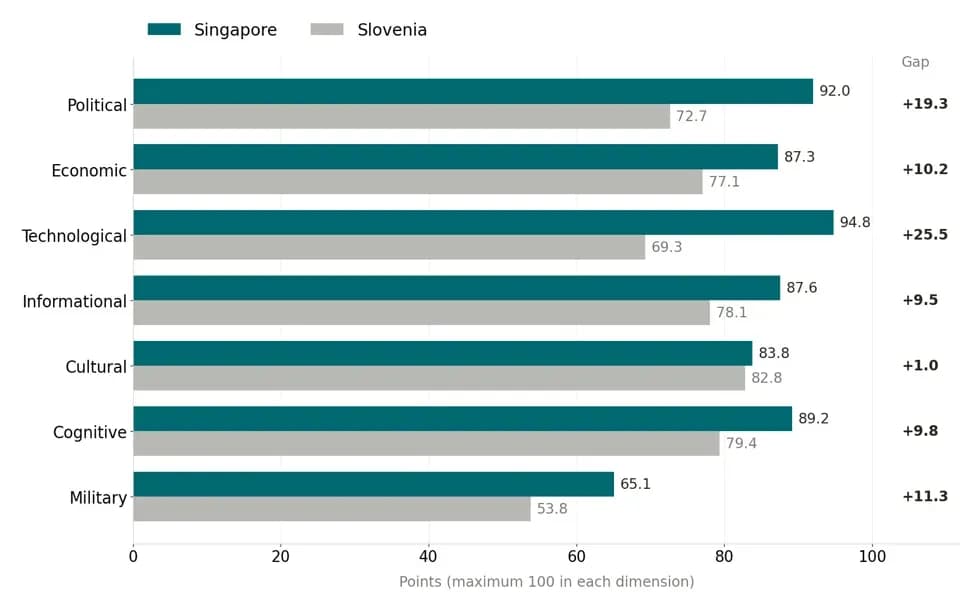 Figure 1. Sovereign Capability Scores by Dimension The data yield four observations relevant to testing the argument. First, the gap is concentrated in functional dimensions. Combining the political, economic, and technological dimensions into a “functional block” yields 274.1 points for Singapore and 219.1 for Slovenia. The difference of 55 points accounts for approximately 63.5% of the overall gap. The technological and political dimensions together account for 51.7% of the gap. These dimensions correspond most closely to SOS—the capacity to shape rules—and Sovereign Conversion—the capacity to translate position into influence. Second, the cultural dimension serves as a control variable. The difference of 1 point, 83.8 versus 82.8, indicates that the countries are virtually comparable in soft attractiveness, identity, and cultural presence. The difference in the aggregate index therefore cannot be explained by cultural factors or characteristics of national identity; it is explained by their functional roles in networks. Third, the countries’ profiles are mirror images. Singapore’s strongest dimensions are technological (94.8) and political (92.0), while the cultural dimension ranks second to last. In Slovenia, by contrast, the cultural dimension leads (82.8), followed by the cognitive and informational dimensions, while the weakest nonmilitary dimensions are technological (69.3) and political (72.7). Singapore’s is the profile of a hub; Slovenia’s is that of a well-integrated society that does not control critical network functions. Fourth, the military dimension is the weakest for both countries. Singapore spends approximately 3% of GDP on defense—a substantial amount for a small state—yet its military score remains its lowest (65.1). This confirms that hub sovereignty is nonmilitary in nature: it rests on the cost of excluding the country from the system rather than on coercive capacity. Excluding the military dimension actually increases the relative gap: Singapore’s average score across the six nonmilitary dimensions is 89.1, compared with Slovenia’s 76.6. 5. Singapore: The Sovereignty of a Multifunctional Hub 5.1. A Portfolio of Indispensable Functions Singapore’s positional strength derives from the overlap of several functions rather than any single one. In 2025, its port handled a record 44.66 million TEU, while total vessel arrivals reached 3.22 billion gross tons; Singapore ranks second globally in container throughput after Shanghai. The Ministry of Transport describes it as the world’s largest container transshipment hub—a node through which flows pass that are not destined for Singapore itself. In finance, Singapore is the world’s third-largest foreign exchange center after the United Kingdom and the United States: average daily turnover reached USD 1.485 trillion in April 2025, while its share of the global foreign exchange market rose from 9.5% to 11.8%. According to the Bank for International Settlements, four jurisdictions—the United Kingdom, the United States, Singapore, and Hong Kong—account for 75% of global foreign exchange trading. Singapore ranks fourth in the Global Financial Centers Index, GFCI 40. In technology, Singapore accounts for approximately 10% of global semiconductor output, 5% of global wafer fabrication capacity, and approximately 20% of global semiconductor equipment production. The last figure is particularly important: the country controls a tooling layer of the chain on which fabrication plants worldwide depend, rather than mass output alone. Finally, Changi Airport handled a record 69.98 million passengers in 2025. 5.2. Producing Rules The most revealing feature of the Singaporean model is the transition from servicing flows to producing the rules governing them. Singapore has a network of 29 trade agreements in force covering virtually all major economies—from the United States and China to the EU, India, and the MERCOSUR countries. This gives it the highest value on Alternatives: the country is not tied to a single bloc and can draw on different frameworks as circumstances change. The Digital Economy Partnership Agreement (DEPA) illustrates SOS even more clearly. Founded by Singapore, Chile, and New Zealand, it is the world’s first standalone digital trade agreement. The Republic of Korea joined in 2024 and Costa Rica in 2026, while eight other economies, including China and Canada, have applied. Singapore chaired the working group on Korea’s accession. A small state thus acts as a coauthor of a regime that substantially larger economies seek to join—a direct instance of shaping the institutional conditions of interdependence. 5.3. Neutrality as a Resource and a Risk Singapore’s diversified external orientation enables it to function as a neutral platform. Industry reviews note that companies use Singapore as a neutral export base to navigate US-China trade tensions while complying with changing export control regimes. Boundaries is evident here: Singapore determines its own customs, monetary, and regulatory regimes and uses boundaries as an instrument to calibrate openness. The model, however, carries costs. The high correlation between GDP growth and global trade makes the country exceptionally sensitive to global shocks. Moreover, in Farrell and Newman’s account, a hub through which critical flows pass becomes a target of pressure from great powers seeking to use it for their own purposes. Hub sovereignty is a capacity to bargain, not a guarantee of security; it must be continually reproduced by maintaining the indispensability of its functions. 6. Slovenia: The Sovereignty of an Embedded Participant 6.1. The Benefits and Constraints of European Shelter Slovenia has adopted the shelter strategy in an almost ideal form. EU and NATO membership, the euro area, and the Schengen Area have provided access to the largest single market, macroeconomic stability, and collective security guarantees. The price of this choice is the transfer of key boundaries to the supranational level. Customs and trade policy are determined by the EU, monetary policy by the European Central Bank, and external borders by the Schengen regime. On Boundaries, Slovenia therefore occupies the opposite pole from Singapore: its boundaries are shared and cannot be changed unilaterally. The value of Alternatives also declines. Approximately 75% of the country’s foreign trade is with the EU, while trade policy toward third countries is conducted by Brussels. Slovenia cannot independently conclude trade agreements like Singapore’s, and switching between networks is constrained by the Union’s common policy framework. 6.2. Koper: A Significant but Replaceable Hub Slovenia’s logistics asset, the Port of Koper, has demonstrated strong growth. In 2025, its container terminal achieved a record 1,272,161 TEU, up 12% from the previous year. According to Prime Minister Robert Golob, approximately two-thirds of the port’s cargo goes to Central European countries; the new Divača-Koper railway, 27.1 kilometers long and costing EUR 1.109 billion, is intended to connect the port with its Central European hinterland. It entered service in March 2026, and the government has already approved an investment program for a third track, which will raise capacity to approximately 252 trains per day. In terms of Sovereign Conversion, however, Koper’s position differs fundamentally from Singapore’s. Their scale differs by a factor of approximately 35, but another distinction is more important: Koper has close substitutes—Trieste, Rijeka, and the North Sea ports. Industry publications explicitly identify Trieste and Rijeka as direct competitors. External actors have an interest in Koper, but its exclusion would not threaten the functioning of the entire system and therefore does not generate the high exclusion costs on which hub sovereignty rests. 6.3. Pharmaceuticals: A Corporate Rather than a State Hub The most interesting aspect of the Slovenian case is pharmaceuticals. The sector accounts for approximately 44% of merchandise exports, while Switzerland is the largest buyer, accounting for 42.2% of total exports. According to Swiss customs data, chemical and pharmaceutical products account for 98% of Swiss imports from Slovenia, and the value of these imports reached CHF 25.9 billion in 2025. The pharmaceutical companies Lek and Krka are among the country’s largest exporters. Formally, this makes Slovenia a significant hub in Europe’s pharmaceutical chain. Yet this hub is substantially corporate rather than governmental: key decisions concerning production location, logistics, and markets are made within multinational groups. A critical function exists, but the state exercises limited control over it and cannot directly convert it into bargaining power. This clearly illustrates the distinction between possessing an advantageous position and having the capacity to convert it. 6.4. Influence through Institutions: The Croatian Episode It would be incorrect to conclude that Slovenia cannot shape the terms of interdependence. Its influence operates differently—through the procedures of collective institutions. The clearest example is the border dispute with Croatia over the Bay of Piran. From December 2008 until the fall of 2009, Slovenia blocked 13 negotiating chapters in Croatia’s EU accession process, remaining the only member state to insist on the blockade despite the European Commission’s opposition. Observers noted at the time that Ljubljana had made its position clear: Croatia would have to make a concession if it wanted to join the EU. The result was the 2009 arbitration agreement; the 2017 award of the Permanent Court of Arbitration granted Slovenia approximately three-quarters of the bay and a corridor to international waters, although Croatia refused to recognize it as binding. The episode shows that a small state within a dense system of rules can achieve an outcome by using its veto as a procedural chokepoint. This form of influence, however, has three limitations: it is episodic, creates reputational costs within the coalition, and uses the network’s rules without changing its structure. Multilateral diplomacy provides another channel. In 2024-2025, Slovenia served as a nonpermanent member of the UN Security Council and held its presidency in September 2024; it had previously held the presidency of the Council of the EU twice, in 2008 and 2021. These episodes raise the country’s visibility and strengthen its political and informational dimensions, but rely on rotational and procedural mechanisms rather than the indispensability of its functions. 7. Comparative Synthesis across the Four Variables The comparison of the cases across the four variables is summarized in Table 4. Table 4. Singapore and Slovenia Compared across the Analytical Variables
The synthesis shows that the difference cannot be reduced to “more” or “less” integration. Both countries are deeply embedded in external networks. The crucial distinction lies in who has the authority to determine the terms of that participation. Singapore has constructed a position in which numerous external actors have an interest in preserving its functions and therefore accept it as an autonomous participant in rule formation. Slovenia has obtained guarantees and markets from a collective structure, but its functions are either replaceable or controlled by nonstate actors, so its influence is exercised predominantly indirectly. The index results are consistent with this interpretation. The largest gap occurs in the technological dimension, where Singapore controls a link that is difficult to replace—semiconductor equipment—while Slovenia is embedded in production chains controlled by others. The second-largest gap is in the political dimension, reflecting the state’s capacity to formulate rules and choose partners independently. The smallest gap is in the cultural dimension, where network position is not decisive. 8. Discussion: When Participation Becomes Influence The comparison identifies four conditions under which a small state’s network participation is transformed from dependence into a capacity to influence network structure.
The discussion nevertheless requires several qualifications. First, the national index probably understates Slovenia’s influence. Slovenia exercises some of its agency as a coalition member—through voting, vetoes, and presidencies—and a national metric captures this only partially. This may be understood as a form of pooled sovereignty: a small state relinquishes some autonomy in exchange for a voice in the decisions of a larger structure. Second, Slovenia’s strategy is rational within its own context. For a state in the center of Europe, surrounded by members of the same Union, the shelter strategy provides high levels of security and prosperity at comparatively low risk. The hub strategy, by contrast, requires the continuous reproduction of indispensability, high state capacity, and a willingness to live with heightened sensitivity to global shocks. Third, the indices capture outcomes rather than mechanisms. Rigorous testing of causality requires process evidence: detailed examinations of episodes in which a state changed the terms of interdependence or failed to do so. The DEPA episode and the blockade of accession negotiations with Croatia are steps in this direction, but a fuller conclusion requires a larger number of cases. Finally, the comparison shows that the choice between strategies is not binary. Slovenia is already moving toward a hub logic through the modernization of the railway corridor to Koper and terminal expansion. Yet without independent control over boundaries and with close competitors available, this strengthens its role within the European network more than it transforms the country into an autonomous center. Conclusion The analysis thus allows us to resolve the central puzzle identified in the introduction. The difference between Singapore and Slovenia is the difference between hub sovereignty and the sovereignty of an embedded participant. Singapore acquires agency because it controls functions that several global systems simultaneously cannot quickly replace: maritime transshipment, foreign exchange trading, semiconductor equipment production, and aviation transit. This raises the cost of excluding it from the system and enables it to help create rules that larger economies subsequently join. Slovenia derives substantial benefits from EU integration, but its functions are either replaceable within a single dense legal framework or controlled by multinational corporations. Its influence therefore operates primarily through collective institutions and procedures rather than through network position itself. Empirically, the index scores confirm this finding. Despite comparable cultural potential—a gap of only 1 point—and approximately half the trade dependence, Slovenia trails Singapore by 86.6 points, with approximately two-thirds of the gap concentrated in the functional dimensions: political, economic, and technological. This confirms the article’s central argument: small states compensate for their size through the quality of their position within a network rather than autonomy from it. Emergent sovereignty arises where external actors have a greater interest in preserving a state’s functions than in replacing them. | |||||||||||||||||||||||||||||||||||||||||||||||||||||||||||||||||||||||||||||||||||||||||||||||||||||||||